Our daughter Teenya connected us with one of her the customers of her beauty shop, back in the spring. During this trip Olivia had been corresponding with a her. We had figured we should meet or pass this day.
We stopped in Sterling to eat at Susie’s. The food was wonderful. We split a seafood platter. It was more than enough for the two of us. As we finished Karen called. Sure enough, they were to camp on the Kenai River close to Cooper Landing. We were headed that way so we had a destination.
The drive along the Kenai where the Russian River joins it is a
 very popular place
  to fish.
We pulled into the campground just off the highway and parked. Karen, her husband and their traveling friends came right behind us. After they parked they brought their chairs, because we had the
 only space with shade. This was the warmest day in weeks. The temperature rose to near 70. So we sat and had a good time becoming acquainted. The two couples are traveling together and are from Colorado.
 Their mission in this trip is to catch salmon. They plan to stay on the Kenai peninsula until they have their fill. Roger found out where to go and planned to get up at 2:00 am and go when it wasn't crowded.
Saturday, June 25 as we were going through our morning ritual we noticed Roger’s truck was back. Seems he got up at 2:00 o’clock and found it was dark, so went back to bed and started again at four. He fished for several hours before finding the fish, but ended up with three sockeye salmon. Fred said they were beautiful. The meat was such a wonderful red color, his mouth watered. Good for him. As it turned out the fishing was spotty. Very few catching fish.
After having coffee with Karen and Gary we told Jane and Roger goodbye and maybe we will see them again, but first there was good weather predicted for Sunday in Seward and a boat trip to see the glaciers from the water in Kenai National Park.
We found a parking place in the Municipal Campground in Seward right on the water. It is a huge parking lot with back in spaces and a place for the car for $15 with no hookups. We took the last of the spots. Olivia can look out the slide windows and see the water with the mountains in the back ground. Too bad they were covered with clouds. We were keeping our fingers crossed hoping for the sun.
We drove to see
 Exit glacier and in the visitor center found this whole area was mountains and in the higher elevations it was covered with an ice field. As the ice field grew each year with more snow the edges started moving down the valleys, causing glaciers.
 The relief map in the center
 showed what this looked like from the air.
Sunday, June 26 we were on the dock at 9:15 to get our boarding tickets for our Kenai Fjords National Park full day cruise. This park has thirty-eight glaciers. The weather forecast had been sunny for this day, but they miss it!
We were
 socked in.
 We traveled to the Kenai NP where wildlife was abundant. We covered 120 miles seeing Eagles, otter, horned puffins, before we came to Bear Glacier. We saw it at a distance with it’s icebergs. The NP ranger told us all about the area and all the animals. He brought around a picture of
 Bear Glacier from the air, as it’s lake has a moraine blocking
 our entry closer to the glacier.
 Glaciers begin humbly, as moisture. Clouds gather off the Gulf of Alaska coast, where the Aleutian Low, a low atmospheric pressure system, spins counterclockwise. Wet weather bathes the coast in jewel green colors. Colliding against the coast’s steep mountains, it also rises and cools as it moves inland, becoming snow. The low spends steadily, the snow gathers, its largest reservoir the 700 square-mile Harding Ice field that mantles the National Park. Instead of melting seasonally, the snow compacts into thickening layers of ice. Time allows the ice to condense until it is nine times denser than ordinary snow. Gravity allows the ice to become a true glacier. A glacier that plows all the way into the sea calves there, noisily. The boom and echo of splashing ice can be heard from miles away. The Harding ice field is the largest ice field located entirely with the US.
Around the point we saw the
 three hole point and the water became very rough for about an hour. Several on the boat became seasick. Fortunately we had taken Dramamine and were ok. Then we entered the Holgate Arm where the crew started serving the all you can eat buffet. Salmon and prime rib, rice and salad.
 We started seeing the Holgate glacier. Olivia put on her raincoat, but not her big coat before going outside on the bow of the ship watching for the glacier to calve.
This was on
 Olivia’s bucket list. Holgate glacier is
  600’ high above water and 300’ below water. The picture is blurry because that spot was rain.
Several times it cracked like thunder and a few small pieces broke off, but no big ones. The boat stayed near this
 glacier about 20 minutes and Olivia stayed outside the whole time. It was cold and rainy. BRRRR! Olivia was ready to come back in to warm up and eat her lunch.
 After lunch was cleared the crew announce they had retrieved a piece of the ice from the glacier. This ice was over 200 years old. They served

margaritas over this ice to those who wanted to pay $6.00.
We hurried over the same rough water and back to Barwell island off Resurrection Peninsula. Barwell was one of the USA’s protection places during WW2.
Resurrection Bay, like all fjords was carved by ice. When the glacier receded and sea levels rose, the U-shaped valley became a steep-sided bay, like many other fingers of water into this land.
The Captain started finding wildlife and the first were several whales very close to the island, then
 Kitty Links, other birds and
  Stellar sea lions.
It was a nice trip, but would have been much better in the sunshine. We are so thankful the Fulton’s gave us a coupon book they hadn’t used as it saved us $149. Thank you!
Monday, June 27 was a lazy day. We slept until nine am and took it easy. About noon we decided to poke around town. We ran into Safeway to pick up a few items and found the power was out. Not just for the store but all over town.
Since we were staying in the municipal park with no hookups we didn’t realize the power outage was upon us. Safeway had backup for the cash registers so we didn’t have a problem checking out. Fred’s cappucino was the next stop and the power outage was a problem. The machines didn’t work. We waited a few minutes then drove around the town. Seeing the lights on the filing station we went back to get cappucino.
A little road attracted us to see where it led, so we drove to

Lowell Point and found two RV parks/campgrounds, the sewage treatment center and a bunch of junkie stuff. The drive was pleasant thought. Back in town we visited the Sea Life museum’s gift shop, then browsed the stores of down town. We did see some nice items, but nothing we couldn’t live without.
One of the shop owners told Fred just what we suspected. This was unusual weather. The normal daily low for this time of year is in the upper 50s with highs in the seventies. We had been having lows in the low 40s and highs in the fifties. This might sound awfully good to our Texas friends, but we are wishing for some warmer weather. Our shorts go unused!
Tuesday, June 28 we drove west back to Soldotna hoping to find some salmon running and a place to spend the 4th of July. We nested at the city’s Centennial park backed up to the

Kenai River which is a popular place to catch Salmon. They don’t run here again until about the middle of July. The city has set up ramps and ladders to the banks for fishermen. We found the unusual weather has affected the timing of the salmon run. We say runs because there are multiple runs during the summer for kings, sockeye and pink. They usually don’t run together.
We scouted out the fishing in the Kasilof river south of here, but it didn’t look promising. We did see a
 yearling moose beside us which crossed the road.
Wednesday, June 29, we cleaned our trailer and washed clothes before we decided to see the town of Kenai and visit with Karen and her bunch. They were camped on top of the bluff and had been fishing from the beach, without any luck . They plan to go clamming further south.
Thursday, June 30, this day was a shopping day, groceries and propane. We stopped at the visitor center to find out about fishing and 4th of July activities before returning to the Kasilof River where Crooked Creek comes in. We saw people fishing and actually witnessed a King salmon caught. They released this big fish and we were told it was because he was so red, the meat would be mushy. It had been in the river too long. Others fishing in the river had caught a few sockeye and they were also red, but they were keeping them.
We need to tell about the hours of daylight here. Olivia woke up at 11:00 pm and took a picture of the
 sun shining in the window. It sets about 11:30 but doesn’t go very far below the horizon causing light until about 2:00 am. Then it starts being light again about 4 am with sunrise at 4:30 am. Fred thought he would have difficulty sleeping with so many hours of light. Well he thought wrong, as usual he sleeps like a log.
 Another fact we had heard is true. The cost of everything is much more than in the lower 48. Example: our high fiber cereal, if the flavor can even be found. At home we buy it for about $3.00 a box. We paid $3.50 in Oregon. It is $5.50 here.
Gas is around $4.25 on the Kenai, $4.15 in Anchorage and it goes up away from those areas.
Friday, July 1, we were at loose ends and didn’t have anything to do this day but read. We did have some coupons for buy one get one free donut so we went to get Fred’s cappucino and the donuts. We explored the Funny River road and didn’t see anything funny. Back at the trailer we decided to have lunch on another buy one get one free. This time at Acapulco's for Mexican food. We hadn’t had any in a long time, knowing it wouldn’t be the same as at home or New Mexico. It wasn’t the same, but the flavor was close. Thanks again to the Fulton's for the coupons.
Back at the campground we walked the trail along the river all the way to the boat ramp where we met the guide boats coming in. We saw one king salmon being
 filleted, then another fresh out of the boat
  with the proud fishermen, then there were
 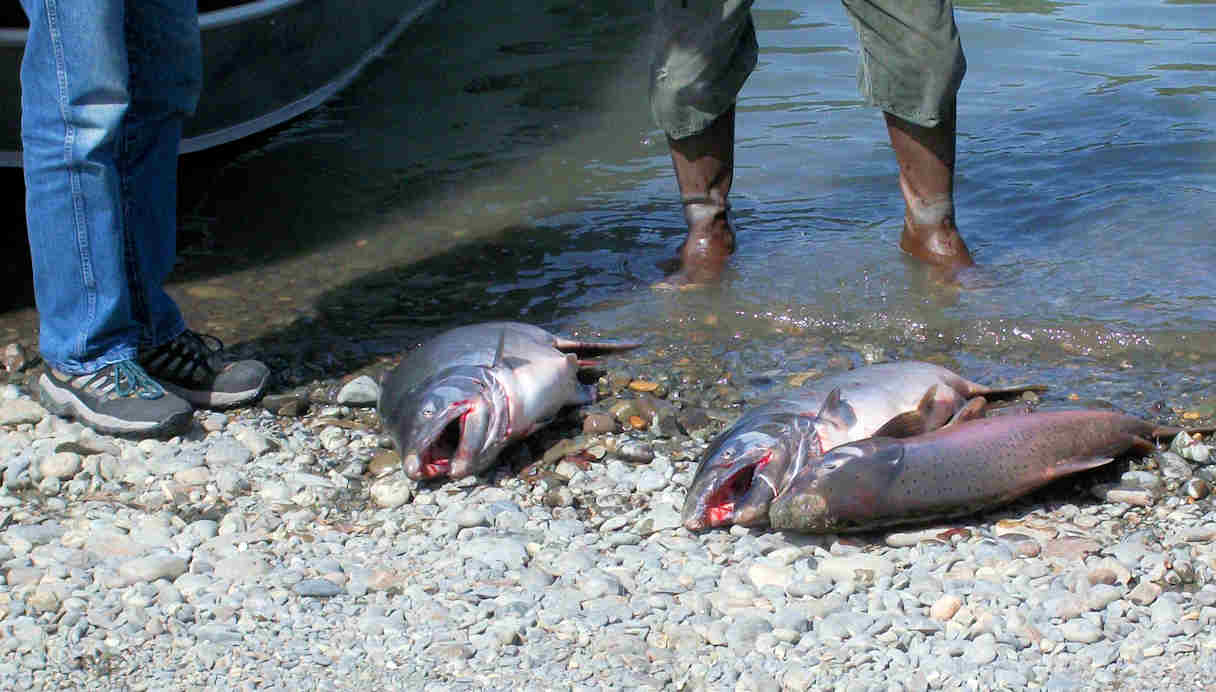 three on the ground. It was interesting to see a State of Alaska staff measuring the salmon and taking a sample of each king.
 So now we see the second king salmon run has started even before the sockeye run is going good. This is unusual.
Saturday, July 2, we woke up to a slow steady rain and it continued until after lunch. Going into town for cappucino and gas we decided to follow up on a flier Olivia picked up in the visitor’s center. It was from B.E.A.C.H.M. Fishery in Kasilof (ka-sea’-lof). The prices in the ad were too good to be true. Fred called and we headed south. We found their processing plant next to their home. It turned out to be a commercial fishing operation. The fishermen had just arrived with the morning catch—276 sockeye from the bay. They catch, then sell. They do very little processing.
They were so nice to us. Fred decided on
 two fresh sockeye salmon and the
  crew processed it. The lady on the right was the owner and the rest were college kids working for the summer.
 They came from Oregon, Montana, Tennessee, Georgia and Wisconsin. They said it was hard work, but was fun work. The owners treat them like family and feed them well. The students talked about how good the salmon was. This experience was more fun than fishing and a whole lot easier.
Even though they don’t normally process fish, they happily agreed to what Fred wanted. They filleted the fish cut them into individual serving sizes and shrink wrapped them. We were charged $2.45 per pound of live weight for the fish. The live weight was 15 pounds. They gave Fred the shrinking and ask that we tip the hands. We gave them $40 for about 11 pounds of processed fish. It looked wonderful. The owner told us that king salmon had much more fat than sockeye, so it was harder to over cook kings. Sockeye should not be over cooked. Their effort to attract retail business to this out of the way location had not gone well. We were the only customers—maybe the only ones for the day and they treated us royally. We got a super deal.
If you want a great summer job for your grandkids—call 907 262 3233 or visit on-line at—www.alaskasbestwildsalmon.com.
Some of you may wonder why Fred didn’t catch his own. The answer is complicated.
First you can catch river fish from the bank or from a boat. Fred has no boat so he would have to hire a guide for about $135. Or he could buy waders and the right bank equipment. That’s not a problem. Most all river fish have already started dying and he believes the taste and texture would be degraded. The biggest problem is the fish just have not cooperated and we are not here at the right time. They have run in such small numbers that fishing for them would be very iffy. Fred is okay with not fishing besides he has a head cold and doesn’t feel like fishing. Eating them is best part and we have done that.
On our way back to the highway we saw
 another moose. This one posed for us.
All around our camp spot was ground cover like plants with little white
 four leaf flowers. Olivia said, they looked like a dogwood flower. She looked it up and sure enough it is a dwarf dogwood, with the purple center being the flower, and the white the modified leaf. It is also called a Bunchberry as the centers turn into a tight cluster of bright-red berries in early August. Too bad our timing is wrong for them too.
We would love to hear from you, so email us by clicking on
Olivia@bobheck.com or Fredharrington@yahoo.com


 a href="https://blogger.googleusercontent.com/img/b/R29vZ2xl/AVvXsEj7iDHfOdaS8yyNhtFCOgoDrmYRlNcK8B12DiJ24Eh2T0Hx00k-up5ZPZPPDtZJo8r_flGH68hUdKBklLPN9sCWEfzDn7zspx2RYopEJQUnVBHvKtE6Xu6HPrukOdzgiB0sOvAdHPyvrSYF/s1600/14-7+Gunsight.jpg">


 Knik River toward the Knik glacier. This was because we read Michner’s Alaska. One of the stories he told about was the Matanuska Colony. We were currently in the Matanuska Valley and it covers a huge area.


 specialty of the house and Fred a

 far right end. There are also more on the opposite side of the store. Since the national and state parks don’t have any hookups, this is just a good, just minus some scenery.


